



 EN
EN  RU
RU 
Over the past decade, companies have been forced to reconsider how they deploy and manage their digital assets. Data loads have increased, power consumption has increased, and the expectation of uptime has increased as well. Traditional data centers that are brick-and-mortar have a tendency to lag behind the rate at which modern organizations need to increase their scale. This is the place where the modular data center comes into play, altering the base on which digital operations are conducted.
A modular data center is not simply a “container with servers.” It represents a significant alteration to the way data centers are constructed, maintained, and deployed. It aggregates essential infrastructure into a pre-fabricated and standardized module that can be deployed quickly and then expanded gradually. This has led to a modular approach that changes the way companies think about cost, scale, and consistency.
Defining the Modular Data Center
A modular data center that is modularized is sometimes called a pre-fabricated data center, modular IT infrastructure, or a data center container. It’s a fully integrated data center that is built off-site in a controlled environment that resembles a factory. Once it’s finished, it is transferred to the customer’s area, connected to utilities, and immediately utilized.
What makes it “modular” is the segmentation of infrastructure into repeatable units. A single module may include:
- IT equipment racks
- Power distribution units
- UPS and battery systems
- Cooling and HVAC systems
- Fire suppression
- Monitoring and security components
- Backup generator integration points
The module is designed as a complete system. Instead of building walls, floors, mechanical rooms, and cable conduits that would take several months to construct, organizations are given a pre-fab building block that already contains all of the necessary components to operate as a data center.
For organizations with rapidly evolving IT requirements, this method provides unprecedented flexibility. Capacity can be augmented by deploying additional modules, which will allow businesses to scale horizontally instead of destroying and then rebuilding entire facilities.
Why Modular Data Centers Are Transforming IT Infrastructure
Traditional data centers are typically expensive, slow to build, and difficult to expand. Their infrastructure grows outdated quickly, leaving businesses with rigid, long-term constructions that lack flexibility. In contrast, modular data centers solve these issues through prefabrication, standardization, and mobility.
Organizations choose modular data centers for several reasons:
- Rapid deployment — A modular data center can be delivered and operational in weeks rather than months.
- Predictable performance — All systems are pre-tested before shipping.
- Scalable architecture — Capacity can grow one module at a time.
- Lower operational risk — Factory-built environments reduce construction variability.
- Enhanced resilience — Consistent engineering ensures stable operation under diverse conditions.
- Suitable for edge computing — Modules can be deployed in remote or space-limited sites.
Because of these advantages, modular data centers are becoming the preferred approach for telecom, finance, healthcare, cloud services, AI computing workloads, and even government critical operations.
Modular Data Center Infrastructure
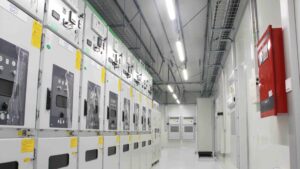
To grasp how a modular data center works, it is essential to understand its internal infrastructure. While the exact configuration varies based on customer requirements, several core systems are present in every modular solution.
Power Infrastructure
The power system is the core of a modular data center that is modular. It’s typically composed of input switches, distribution cabinets, UPS units, batteries, grounding systems, and automatic transfer switches for the purpose of integrating generators. These components guarantee a dependable and consistent supply of energy for IT tasks.
UPS Systems
To maintain power quality and consistency, data centers that are modular utilize UPS systems that can handle the entire IT load and cooling requirements. They compensate for voltage drops, power outages, and short periods of power, providing a smooth transition to generator power when necessary.
Cooling and temperature control systems
High-density computers and servers produce significant heat. Modular data centers utilize air conditioning that is precision-focused, in-therow cooling, or chilled water depending on the project’s requirements. Their cooling equipment maintains a consistent environment that ensures the stability of server operation.
Fire Protection
Because data centers are modular and contain high-value environments, fire protection is mandatory. Many modules utilize gas-based suppression (FM200, Novec 1230, or similar) to extinguish fires without negatively impacting electronic devices. Sensors, alerts, and automated systems are combined with monitoring software that provides immediate response.
Monitoring and Control
Smart monitoring systems that are intelligent follow the environmental conditions, electrical components, equipment, and safety. These systems are considered the “central nervous system” of a data center that has multiple components; these systems are supportive of predictions and quick resolution.
Replacement Generators
Although generators may not be located inside the module, data centers that are modular often have a connection to a standalone generator that is continuous to ensure power is not interrupted during extended outages.
All of these components together create an engineered IT environment that is reliable from the first day.
Daily Operation and Maintenance of Modular Data Centers
A modular data center may be prefabricated, but it still requires consistent operation and maintenance to ensure safe and stable performance. Daily O&M is the lifeline of the system.
Daily duty management includes monitoring equipment conditions, preventing failures, coordinating personnel, and responding to emergencies. Because modular units operate continuously, the responsibility of the duty team becomes essential to keeping all infrastructure in a healthy state.
Below is a structured look at how daily operation and maintenance work:
Constant Monitoring
Duty personnel must pay attention to the power system, the UPS, the battery, the temperature, humidity, and security systems. Real-time awareness promotes the identification of problems early on.
Ordinary Inspections
Technicians typically walk around the module regularly, listen for unusual noises, check for odors, observe the indicator lights, and verify that the cooling systems and power infrastructure are functioning as intended.
Troubleshooting
When uncommon situations occur, duty personnel conduct initial assessments and communicate with technical experts. Fast response minimizes downtime and reduces the risk of severe consequences.
Preventative Maintenance
Every day, tasks that are daily include cleaning, lubrication, checking for connection problems, tightening mechanical components, and replacing consumables. These endeavors increase the lifespan of the equipment and reduce the frequency of failure.
Logging
Logistics management that is detailed enables long-term observation and the identification of trends. Logistics supports improvement efforts and facilitates the technician’s ability to follow recurring problems.
A Practical List of Key O&M Responsibilities
- Inspect power distribution, UPS systems, and generator integration points.
- Verify cooling performance and environmental stability.
- Identify abnormal noise, odor, vibration, or electrical behavior.
- Diagnose faults promptly and coordinate technical support.
- Perform basic maintenance to ensure long-term reliability.
- Record operational conditions meticulously to assist future planning.
These responsibilities form the day-to-day rhythm of modular data center management.
Requirements for Personnel Managing a Modular Data Center
Maintaining a modular data center demands more than basic technical ability. On-duty personnel must possess a combination of responsibility, technical skill, and situational awareness.
High Level of Responsibility
Since modular data centers operate 24/7, duty personnel must remain alert and sensitive to environmental changes. Their decisions directly influence continuity and safety.
Strong Technical Knowledge
Personnel should understand electrical systems, mechanical equipment, HVAC operations, fire suppression systems, and monitoring platforms. Familiarity with modular data center solutions ensures faster troubleshooting.
Emergency Response Skills
When faced with power outages, cooling system failures, or fire alarms, they must respond decisively. Quick action prevents minor faults from escalating into large-scale incidents.
Improving and Optimizing Daily Duty Management
As modular data centers continue to evolve, so must their operational systems. Several methods greatly enhance efficiency and reliability.
Intelligent Monitoring Systems
Advanced monitoring integrates sensors, AI-driven analytics, predictive maintenance tools, and automated early-warning functions. These technologies help detect problems before they impact operations.
Standardized Operating Procedures
Clear procedures ensure uniformity across teams. Training sessions help ensure that duty personnel operate equipment confidently and handle emergencies correctly.
Backup Duty Personnel
Continuous 24-hour work increases fatigue risk. Establishing a rotation system prevents lapses in attention and enhances safety across the modular data center.
Tools That Improve Duty Efficiency
- Centralized monitoring software
- Fault management platforms
- Automated alert systems
- Asset tracking databases
These tools streamline workflow and reduce manual oversight.
Practical Skills for Managing Modular Data Centers
Years of operation in modular environments show that certain practical habits deeply improve reliability:
Continuous Learning
As technologies advance—especially with AI, automation, and edge computing—personnel must learn new systems and stay updated on best practices.
Strong Communication
Duty personnel should communicate effectively with supervisors and engineering teams. Clear reporting accelerates problem resolution.
Accurate Documentation
Operational records help track equipment trends, identify recurring anomalies, and plan maintenance cycles.
Effective Use of Support Tools
Monitoring dashboards, ticketing systems, and diagnostic tools elevate productivity and accuracy.
Purpose and Function of Backup Power in Modular Data Centers
A modular data center’s backup power system exists for one key purpose: to ensure uninterrupted power throughout any failure of the primary supply.
The backup generator set automatically activates when the main utility power fails. Connected through automatic transfer switches, it provides continuous power to:
- UPS units
- Cooling systems
- IT equipment
- Environmental monitoring
- Fire suppression systems
This redundancy ensures that even in extreme conditions, the modular data center remains operational.
The Benefits and Future Outlook of Modular Data Centers
The adoption of modular data centers is not a temporary trend—it is a long-term shift in how organizations build and expand infrastructure. Several advantages highlight why modular design is becoming mainstream:
Cost-Efficiency
Prefabrication reduces the cost of labor, increases the delay of construction, and produces waste that is material. Predictable pricing diminishes the uncertainty associated with traditional approaches.
Scalability
Organizations can begin with a single component that increases in size as demand increases. This incremental funding model is concerned with spending that is proportional to growth.
Global consistency
Because modules are constructed in environments that are controlled environments, the quality of the product remains the same regardless of the destination.
Border Deployment
Modular data centers are beneficial for edge computing because low delay and proximity to the users are crucial.
Frequent Technological Advances
As computers that are AI-based, cloud computing, and distributed across the network increase in popularity, modular data centers have the capacity to add new technologies without necessitating a major re-structuring.
Why Modular Data Centers Are the Future
Faster deployment than traditional data centers
Lower construction risk and predictable performance
Seamless scalability through modular expansion
Strong support for edge computing and remote sites
Standardized engineering that simplifies maintenance
These advantages explain their widespread adoption across industries.
A modular data center is significantly more than a pre-fabricated container: it is an intelligent, scalable, and comprehensive infrastructure that is intended to support digital operations today. It combines power systems, UPS units, cooling, fire protection, monitoring, and supplemental power in a single, factory-engineered component.
As technology develops and the volume of IT tasks increases, modular data centers will continue to augment their presence. Automation, AI-based monitoring, proactive maintenance, and advanced modular design will augment their abilities further. What was originally intended as an alternative to traditional data centers has now become a central part of the strategy of organizations that want to achieve speed, flexibility, and long-term viability.
CIMC TLC|RYC|XLC is a leading manufacturer of modular data center Offices and various other standard and special logistics equipment. With years of experience in the industry, it focuses on the design, production, and distribution of high-quality innovative products that meet the specific needs of customers.
If you need high-quality and innovative logistics equipment, including refrigerated containers, cold chain equipment, containerized equipment integration, modular buildings, etc., CIMC TLC|RYC|XLC is your best choice. We welcome inquiries from customers all over the world and look forward to the opportunity to cooperate with you.