



 EN
EN  RU
RU 
In global trade, where tons of bulk cargo are transported across oceans every single day, the dependability and efficiency of transport equipment have a significant impact on both the cost and quality of the product. Among the unheard of Heroes of this system is a significant participant: the bulk container for shipment. Celebrated for its practicality, durability, and versatility, this container type has revolutionized the way industries deal with unpackaged solids, powdered products, and granular goods.
From fertilizers and grains to chemicals and alternative energy sources, CIMC TLC|RYC|XLC Bulk Containers have become the standard solution utilized by industrial operators around the world. Behind its apparent complexity is a series of years of evolution in the engineering field and a wealth of logistics knowledge that is intended to maximize the safety of cargoes, reduce costs, and improve efficiency.
What a Bulk Shipping Container Really Is
The core of the container is a bulk container (also called a bulk shipping container, bulk sea container, or bulk storage container) that is specialized in the transport of bulk materials that are unshuffled. Instead of employing countless smaller packages, materials are directly loaded into the container’s inner chamber through a loading port at the top and released through a release port at the bottom or rear.
Unlike traditional containers, which are built to hold boxes, pallets, or bags of cargo, a bulk container is specifically designed to deal with the logistics of substances like this:
- Agricultural goods: soybeans, rice, flour, corn, malt, and animal feed.
- Industrial products: cement, minerals, chemicals, and resin pellets.
- Clean energy materials: lithium carbonate, polymer granules, or catalysts.
This design drastically simplifies material handling — removing the need for additional packaging while minimizing waste, contamination, and time spent loading and unloading.
Structure and Functionality: A Smart Design for Complex Needs
A bulk shipping container may appear like a typical 20-foot or 40-foot container from the exterior, but its internal design is far more advanced.
On the innermost layer, the inner walls are covered with waterproof plywood that is coated with fiberglass to prevent corrosion and facilitate easy unloading. This procedure also promotes the prevention of powdery or granular materials from adhering to the sides, which minimizes the amount of residue and reduces the cleaning time.
On top of the box, there are typically two or three loading stations that can accommodate fast addition of conveyor systems or storage silos. Once filled, these ports can be sealed to maintain the airtightness of the container and prevent moisture or leakage during transport.
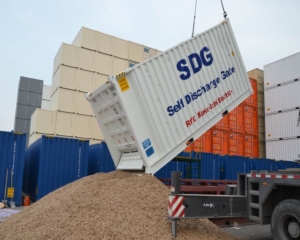
At the conclusion of the discharge, a funnel that allows gravity to unload the payload is present. When combined with an automatic dump truck, the entire procedure is hygienic, effective, and safe. In some instances, a tailgate that automatically disintegrates (a patented design by CIMC TLC|RYC|XLC) is employed, which further simplifies the process of unloading.
Structural Features Overview
| Feature | Description |
|---|---|
| Top Loading Ports | 2–3 hatches for filling solid, granular, or powdered cargo. |
| Inner Lining | Waterproof plywood coated with fiberglass for easy cleaning and corrosion resistance. |
| Rear Discharge System | A canvas funnel or discharge port for safe unloading by tilting the container. |
| Optional Designs | 2 or 3 square roof hatches; self-discharging tailgate; fumigation attachments for grain. |
| Compatibility | ISO 20ft reefer or high-cube container frame; optional inner bags for sensitive cargo. |
This structure ensures adaptability — one of the reasons CIMC TLC|RYC|XLC Bulk Containers are recognized globally for performance consistency and long-term durability.
Why Bulk Containers Dominate Modern Transport Systems
A bulk container offers distinct advantages over traditional bagging or bulk tanker transport systems. These benefits go far beyond logistics cost savings — they influence the entire supply chain from environmental impact to product safety.
Three Key Advantages
- Reduced Packaging Costs
Traditional shipping methods require thousands of individual bags, pallets, or drums — all of which add weight, cost, and waste. Bulk containers eliminate most of that by turning the container itself into the packaging medium. - Cleaner and Safer Work Environment
Since loading and unloading are done through closed systems, dust and particulate matter are significantly reduced. This not only protects workers but also helps companies meet environmental safety standards. - Higher Operational Efficiency
Bulk containers streamline handling processes, enabling direct transfer from storage silos to containers and vice versa. This saves both time and labor, improving turnaround rates at ports and warehouses.
The Role of CIMC TLC|RYC|XLC in Bulk Container Innovation
As a globally recognized manufacturer in the logistics equipment sector, CIMC TLC|RYC|XLC has established itself as a pioneer in bulk shipping container design and production. Their products have been widely adopted in the chemical, agricultural, and clean energy industries.
Distinctive Features of CIMC TLC|RYC|XLC Bulk Containers
- CSC Certification Compliance:
Every container meets the International Convention for Safe Containers (CSC) standards, ensuring global transport compatibility. - Patented Self-Discharge Tailgate:
Simplifies unloading operations, saving time and reducing equipment wear. - Optional Steel Rope Sliding Hatch:
Allows operators to open roof hatches safely from ground level — an innovation that enhances safety. - Inner Lining Customization:
From food-grade coatings to chemical-resistant fiberglass, customization ensures compatibility with different cargo types. - Support for Inner Bags:
Ideal for high-purity or moisture-sensitive goods such as polymer resins or powdered chemicals.
By combining mechanical strength with user-oriented details, CIMC TLC|RYC|XLC ensures that each bulk sea container remains not only a storage unit but an integral part of a smart, sustainable logistics chain.
Cost and Performance: The True Meaning of Bulk Container Cost Optimization
When companies consider transitioning to bulk shipping containers, one of the primary concerns is the bulk container cost. However, this cost should not be viewed in isolation. Instead, it’s part of a total logistics ecosystem that includes packaging, handling, cleaning, and time efficiency.
Factors Influencing Bulk Container Cost
| Factor | Impact |
|---|---|
| Material and Coating | Fiberglass linings or reinforced plywood add to durability but increase unit cost. |
| Customization Level | Tailgates, hatches, and inner bags affect price but improve functionality. |
| Transportation Distance | Reusability and return logistics determine long-term ROI. |
| Cargo Type | High-value materials justify advanced container configurations. |
When viewed holistically, the bulk container emerges as a cost-efficient solution that balances performance, durability, and total life-cycle savings.
Applications Across Multiple Industries
1. Chemical Industry
Bulk shipping containers are widely used for solid chemicals like calcium carbonate, fertilizers, and polymer granules. The sealed design ensures no contamination, while the anti-corrosion coating protects the cargo from moisture or reaction with container surfaces.
2. Clean Energy Sector
In the rapidly expanding field of clean energy, materials like lithium compounds and electrolytes are sensitive to air and moisture. CIMC TLC|RYC|XLC Bulk Containers with specialized linings provide an ideal transport environment.
3. Agriculture and Food
For bulk grains, rice, or malt, containers equipped with fumigation ports allow in-transit pest control without cargo exposure — preserving quality and hygiene.
4. Construction and Cement Industry
Cement, sand, and fly ash are efficiently handled with self-discharging containers, eliminating the need for additional silos or transfer systems.
These examples demonstrate that bulk containers are not limited to one niche. They form an adaptable foundation across multiple logistics scenarios — from energy to agriculture.

Comparing Bulk Containers to Alternative Transport Methods
| Transport Method | Advantages | Limitations |
|---|---|---|
| Bulk Container | Flexible, reusable, clean loading/unloading, global shipping standard. | Requires specialized equipment for tilting or discharge. |
| Bulk Tanker Truck | Great for liquid transport, fast discharge. | Limited for dry bulk, high cost for long-distance shipping. |
| Bag-in-Box Packaging | Protects small volumes, easier to handle. | Generates waste, higher per-unit cost. |
| Rail Bulk Hopper | Efficient for large domestic routes. | Less flexible internationally, infrastructure dependent. |
The bulk shipping container stands out for its global adaptability — compatible with maritime, rail, and road logistics networks.
Environmental Benefits and Sustainability
One of the growing advantages of bulk shipping containers is their alignment with sustainable logistics strategies. By replacing single-use packaging materials with reusable containers, companies can drastically reduce waste and emissions.
Key sustainability aspects include:
- Reduced Plastic and Paper Use: No need for thousands of disposable bags.
- Lower Carbon Footprint: Optimized loading and fewer transfers reduce total energy use.
- Reusability: Containers can be refurbished and used multiple times across industries.
- Cleaner Operations: Enclosed loading systems minimize air pollution and spillage.
CIMC TLC|RYC|XLC’s long-lasting coatings and repairable construction further extend the container’s life cycle, aligning with green logistics goals.
Future Trends: Intelligent Bulk Shipping Systems
As logistics becomes smarter and more data-driven, bulk containers are evolving too. In the near future, we can expect the integration of:
- IoT Monitoring: Sensors for temperature, humidity, and cargo movement.
- Automated Unloading Systems: Fully mechanized discharging via robotic tilting platforms.
- Material Optimization: Lightweight composites and recycled steel for structural panels.
- Global Tracking: Real-time GPS and RFID integration for supply chain transparency.
These innovations ensure that the humble bulk storage container will continue to play a central role in sustainable logistics for decades to come.
The Enduring Value of Bulk Shipping Containers
From its humble start as a practical method of moving grains and powdered substances, the bulk shipping container has progressed to be a part of modern logistics. It achieves unparalleled efficiency, safety, and versatility while also decreasing costs and environmental impact.
CIMC TLC|RYC|XLC Bulk Containers, with their recognized structural advantages, superior quality, and international recognition, are the future-ready containers for industrial logistics. Whether it’s chemicals, renewable energy, or agriculture, these containers facilitate an efficient movement of cargo from the factory’s floor to the farthest port.
The success of global logistics is dependent on both speed and intelligence, as well as sustainability and reliability, all of which are exemplified in every CIMC TLC|RYC|XLC Bulk Container.