


 EN
EN  RU
RU 
In the world of large-scale industrial endeavors, such as remote gold mining in the Australian outback, the Middle East’s oil and gas exploration, or mountain infrastructure development, there is a singular, challenging problem that every project manager must address: accommodating the workforce.
This is more than simply providing a place to sleep. It’s concerned with creating a safe, comfortable, and functional habitat that can attract and retain skilled labor in some of the most challenging locations on the planet. Over time, the solutions have been a difficult mixture. Traditional methods are prohibitively costly and slow. Converted containers are intended to be sturdy, but they often have to be cramped and lack insulation. Less expensive temporary accommodations do not provide the quality of life that modern employees demand and deserve.
This practical and financial problem has been recognized as the cost of conducting business for a long time. But what if it wasn’t necessary? What if there was a solution that was quicker to implement, more cost-effective to transport, and provided a superior experience?
Come into the Flatpack Home. This isn’t simply an additional iteration of a temporary structure. It’s a radical approach to remote housing, a complex, factory-made system that is designed to address the fundamental issues of workplace housing. Any company that wants to maximize project budgets, reduce timelines, or improve efficiency in operation must understand the investment proposition of the Flatpack Home; this is no longer necessary as a critical strategic advantage.
The Foundational Advantage: Deconstructing the “Flatpack” Concept
Before we discuss the return on investment, it’s essential to understand what differentiates Flatpack Home. Unlike a traditional pre-fabricated module that is transported as a large, empty box, a Flatpack Home is a complete system that is ingeniously compacted into the size of a common shipping container.
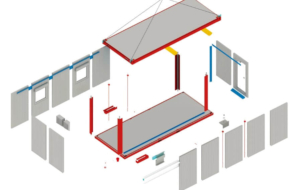
The roof, the base of the floor, the wall panels, and all internal components are pre-fabricated and then combined into a single, compact package. Common configurations are”4-in-1 bundles” that contain four separate housing units that are intended for transport.
This simple idea is the cause of its significant practical and financial benefits. It’s a methodology that is derived from a realization that the greatest expense isn’t always the structure, but the difficult task of transporting it to remote locations.
Drastic Reduction in Logistics & Transportation Costs
For any project manager who has ever had to budget for shipping to a remote location, transportation costs are a major line item that can quickly spiral out of control. Shipping empty air in the form of conventional prefabs is incredibly inefficient.
This is where the Flatpack Home delivers its first, and perhaps most impactful, return on investment.
- A 75% Reduction in Shipping Volume: The “4-in-1” bundled design is a logistical game-changer. Where you would traditionally need four separate trucks or four shipping container slots to transport four housing units, you now only need one. This immediately translates to a saving of up to 75% on transportation costs. For international projects requiring ocean freight or projects in landlocked regions requiring long-haul trucking, these savings are not trivial; they can amount to hundreds of thousands of dollars on a medium-sized camp. A single truckload can deliver enough housing for a small team, transforming the entire logistical equation.
- Simplified Handling and Storage: The standardized, container-sized bundles are easy to handle with standard port and site equipment (cranes, large forklifts). They can be stacked and stored efficiently on-site, requiring less laydown area and simplifying site management before assembly begins.
The investment in a Flatpack Home starts paying dividends before a single bolt is turned, simply by slashing the enormous cost of moving materials to where they are needed most.
Unprecedented Speed of Deployment and Construction
In project management, time is money. Every day saved on construction is a day your workforce can be productive. The lengthy construction schedule of traditional buildings or even complex prefabs is a major source of project delays and budget overruns.
The Flatpack Home is engineered for speed. Its entire design philosophy is centered around rapid, simple, on-site assembly.
- From Bundle to Building in Hours, Not Weeks: The claim that 4 workers can quickly assemble a single Flatpack Home within 2 hours is not a marketing slogan; it’s a reflection of its clever engineering. The process is straightforward and intuitive:
- The foundation is prepared (often a simple, level pad).
- The roof structure is lifted from the pack.
- The four corner posts are installed onto the floor structure and connected to the roof.
- The pre-finished, insulated wall panels are simply inserted and fixed into place.
- Internal electrical fittings and decorative trims are installed.
- Reduced Reliance on Skilled Labor: The assembly process does not require highly specialized construction trades. A small team of general laborers with basic tools and proper supervision can erect the units efficiently. In remote areas where skilled labor is scarce and expensive, this is a massive cost advantage.
- Accelerated Project Timelines: A 100-person camp that might take 6-8 months to build using traditional methods can be made fully operational in a matter of weeks with a Flatpack Home solution. This radical acceleration means your project can start generating revenue sooner, dramatically improving the overall project ROI. This speed also makes the Flatpack Home the undisputed champion for emergency housing and disaster relief, where every hour counts.
Superior Quality of Life & Workforce Retention
In today’s competitive labor market, especially for skilled positions in mining and energy, attracting and retaining top talent is a major challenge. The quality of the on-site accommodation is no longer a minor perk; it’s a critical factor in an employee’s decision to join or stay with a project. A camp with poor living conditions leads to low morale, high turnover, and reduced productivity.
Investing in a Flatpack Home is a direct investment in your most valuable asset: your people.
- A Comfortable and Dignified Environment: Unlike the cramped, spartan interiors of old-fashioned workforce housing, the Flatpack Home is designed for modern living.
- Excellent Insulation: The walls are constructed from composite rock wool insulation wall panels (typically 70mm thick). This provides superior thermal and acoustic insulation compared to standard container walls or uninsulated panels. It keeps the interior cool in the scorching desert heat and warm during cold nights, leading to lower HVAC energy consumption and a far more comfortable living space.
- Fully Prefabricated Interiors: The roofing, flooring, and circuit systems are completely factory prefabricated. This means each Flatpack Home arrives with a finished, high-quality interior. It can be readily equipped with air conditioning, proper lighting, electrical sockets, and comfortable furniture, creating a true “home away from home” environment rather than just a temporary shelter.
- Flexibility and Customization: The modular design allows for incredible flexibility.
- Multiple Configurations: A single Flatpack Home unit can serve as a comfortable two-person accommodation room, a private senior staff office, or a specialized unit like a first-aid station.
- Expandable Spaces: Through side-to-side or end-to-end connection designs, multiple units can be seamlessly joined to create larger, more functional spaces like conference rooms, mess halls, recreation rooms, or entire clinics. This adaptability allows you to create a well-structured, functional community, not just a collection of sleeping quarters.
A comfortable, well-rested worker is a safer, more productive worker. The superior living environment offered by a Flatpack Home is a powerful tool for improving morale and reducing costly employee turnover.
Durability, Sustainability, and Long-Term Asset Value
A common misconception about modular buildings is that they are “temporary” and disposable. A high-quality Flatpack Home, however, is engineered as a durable, long-term asset.
- Robust Structural Engineering: The light steel structure system, featuring corner posts and frame members up to 4.0mm thick, is anything but flimsy. It is designed to provide excellent resistance to environmental stresses, including wind speeds of up to 120km/h. The protective paint system, often involving electrogalvanizing and multi-layer polyurethane coatings, ensures long-term corrosion resistance.
- A 20-Year Lifespan and Reusability: This is a crucial investment metric. A well-maintained Flatpack Home can have a sustainable use for up to 20 years. Furthermore, its greatest advantage is its reusability. When a project concludes, you are not left with a stranded, immovable asset. The units can be disassembled, re-bundled, and transported to the next project site. This ability to redeploy the asset across multiple projects dramatically lowers the total cost of ownership over its lifespan.
- Environmental Responsibility: Sustainability is an increasingly important factor for corporate and governmental projects. The Flatpack Home excels here:
- Minimal Construction Waste: As assembly is the primary on-site activity, the process does not produce any significant construction waste, unlike traditional building methods.
- Recyclability: The primary components (steel, wall panels) can be recycled at the end of the building’s long life.
- Energy Efficiency: As mentioned, the high-quality insulation leads to lower energy consumption for heating and cooling throughout the building’s operational life.
This combination of durability and sustainability means a Flatpack Home is not a sunk cost. It is a flexible, movable, and responsible asset that retains its value far beyond the duration of a single project.
The Smart, Strategic Choice for Modern Projects
When you evaluate the evidence, the conclusion is clear. The decision to use a Flatpack Home for workforce housing or remote camps is not a compromise; it is a strategic upgrade across every critical project metric.
- You invest in Financial Efficiency by slashing transportation and labor costs.
- You invest in Project Speed by reducing construction timelines from months to weeks.
- You invest in Your People by providing a superior, comfortable, and safe living environment that boosts morale and retention.
- You invest in a Durable, Reusable Asset that lowers your total cost of ownership and aligns with modern sustainability goals.
The cost of the initial price tag is only a small portion of the narrative. The actual cost is determined by logistics, personnel, project duration, and employee departure. In every one of these regions, the Flatpack Home has a significantly greater return on investment than other homes. It’s the intelligent, forward-thinking solution that is engineered to address the realities of modern, large-scale remote operations. For the project manager responsible for delivering on time and on budget, the Flatpack Home is not only a more impressive building, but it is also a more effective method of construction.
CIMC TLC | RYC | XLC is a leading manufacturer of flatpack homes and a wide range of standard and customized logistics equipment. With years of industry experience, the company focuses on the design, production, and distribution of high-quality, innovative solutions that meet the specific needs of customers worldwide. Its product portfolio covers refrigerated containers, cold chain systems, containerized equipment integration, modular buildings, and more — all built with precision and creativity.