



 EN
 RU

Quick Answer: A flatpack container is a prefabricated building system designed to be transported in a compact, disassembled form and assembled at the destination. In contrast, a modular container is generally transported in a more complete, three-dimensional form. Therefore, the key difference lies in how the unit is packaged, transported, and assembled rather than in its intended use; flatpack systems prioritise transport efficiency, while fully assembled modular units prioritise installation speed and factory completion.
What Is a Flatpack Container?
A flatpack container is a prefabricated, modular building whose main structural components — typically the roof, floor frame, corner posts, wall panels, doors, windows and associated fittings — are designed to be packed into a compact bundle for transportation. Once delivered, these components can be assembled to create a usable room, office, accommodation unit, sanitary facility, warehouse or other enclosed space.
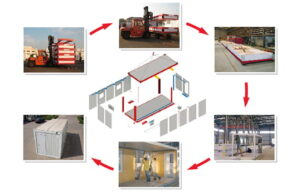
The main idea behind the flatpack concept is simple: to ship more building capacity in a smaller transport volume. Rather than transporting every completed room as a full three-dimensional box, manufacturers separate the structure into components that can be stacked efficiently. For example, our CIMC TLC|RYC describes its flatpack container as a modular building in which the roof, floor, corner posts and wall panels are packed together, with four units packed into one bundle for the standard configuration.
This makes a flatpack container particularly useful when transportation costs, container utilisation, or access to the destination are major considerations. The trade-off is that some assembly work is normally required at the destination, whereas a fully assembled modular container can arrive much closer to its final operational condition.
It is also important not to confuse a flatpack container with a conventional ISO shipping container. ISO shipping containers are primarily designed for cargo transportation and standardised intermodal handling, whereas flatpack containers are generally engineered as prefabricated buildings or accommodation systems. While some modular container products use container-inspired dimensions and lifting features, their structural purpose and internal configuration can differ substantially.
What Is a Modular Container?
The term ‘modular container’ is broader than ‘flatpack container’. In the construction industry, it typically refers to a prefabricated module that is manufactured in a controlled factory environment and designed to form part of a larger building or to function as an independent space.
Modular containers may arrive as completed or substantially completed three-dimensional units. Depending on the design, it may already have electrical wiring, lighting, flooring, doors, windows, insulation, plumbing, sanitary equipment, HVAC components, and interior finishes installed before transportation.
This is why the distinction between the two terms can be confusing. Both systems are modular and can be prefabricated and connected to create larger facilities. The practical difference usually lies in the delivery configuration and degree of factory completion.
A fully assembled module can be advantageous when the customer wants to minimise on-site labour. However, a flatpack system can be more attractive when shipping volume is the dominant concern, especially when many units must be transported over long distances.
Flatpack Container vs. Modular Container: The Main Difference
The simplest way to understand the difference is to imagine transporting ten rooms.
With a fully assembled modular system, each room is transported as a three-dimensional module. This means the truck or vessel is carrying the complete volume of the room, even if much of that internal volume is empty.
With a flatpack system, the same ten rooms can be disassembled into structural panels and frames, allowing multiple units to occupy a much smaller transportation volume. After arrival, the components are separated and assembled into individual rooms.
This gives each system a different optimization target. Flatpack optimizes transportation density; fully assembled modular construction optimizes on-site installation time.
Comparison Factor | Flatpack Container | Fully Assembled Modular Container |
Delivery condition | Disassembled/compact bundle | Completed or substantially completed module |
Transportation volume | Low | Higher |
Shipping efficiency | Very high for multiple units | Lower per completed room |
Site assembly | Required | Limited in many configurations |
Factory completion | Partial to high | Usually high |
Site labor | Moderate | Lower |
| Installation speed per unit | Fast after components arrive | Very fast |
| Customization | High | High |
| Multi-unit projects | Particularly efficient | Suitable but transportation-intensive |
| Storage before installation | Compact | Requires more space |
| Access to remote sites | Good where components can be delivered separately | Depends heavily on module dimensions |
| Best advantage | Lower logistics volume | Reduced site assembly |
The table also explains why neither product should automatically be described as “better.” The appropriate choice depends on whether the project’s biggest constraint is transportation, site labor, installation time, access, or factory completion.
Why Is Flatpack Container Design So Transport-Efficient?
Transportation is one of the strongest reasons to choose a flatpack container. A completed modular room has a fixed external volume, whereas a flatpack room can be compressed into a much smaller package by stacking panels and structural components.
For large accommodation camps, construction offices, temporary schools, sanitary facilities, worker housing, and similar projects, this difference can become significant. The number of units required is often much larger than the number of completed modules that can economically be transported at one time.
The manufacturer therefore designs the roof, floor, wall panels, posts, and accessories to be separated without compromising the structural integrity of the final building. This requires attention to connection design, panel protection, packaging, lifting points, assembly sequence, sealing, and component identification.
How Is a Flatpack Container Assembled?
A flatpack container cannot simply be unfolded like a collapsible box. Its assembly involves a structured construction process, which usually begins with preparing and levelling the foundation.
First, the floor structure is positioned, followed by the corner posts and roof frame. The wall panels are then inserted and secured between the structural members. Finally, doors, windows, electrical components, sealing strips, internal finishes, and other accessories are installed. The exact sequence depends on the manufacturer’s connection system and the final configuration.
The advantage of this is that the assembly process can be repeated systematically. Once a project team has become familiar with one product system, multiple units can often be erected using the same basic workflow, thereby reducing the learning curve associated with each additional building.
However, buyers should not evaluate a flatpack solely based on the number of workers or hours claimed in promotional material. Foundation preparation, unloading, handling components, weather conditions, electrical connections, plumbing, internal finishes, and local building requirements all influence the time taken for actual installation.

Major Advantages of Flatpack Containers
- Lower Transportation Costs
The most obvious benefit is improved transportation efficiency. More units can potentially be moved in one shipment because the components are packed rather than transported as completed rooms.
CIMC TLC|RYC states that its standard flatpack system can package four units into one bundle, with the manufacturer specifically positioning this configuration as a way to reduce transportation costs.
The actual savings will vary according to freight rates, destination, shipment quantity, route, unloading equipment, and local transportation regulations. Nevertheless, transportation density is a fundamental advantage of the flatpack architecture.
- Efficient Storage
Flatpacked components occupy significantly less space than completed modular rooms. This makes them useful when a project requires units to be purchased in advance but installed gradually.
For emergency-response programs, construction projects, seasonal facilities, and large accommodation developments, compact storage can reduce the amount of land required for inventory before installation.
- Flexible Layouts
Flatpack systems can generally be connected side-to-side or end-to-end to create larger spaces. Some systems also support multi-story configurations when the structural design and engineering conditions permit.
This means a basic module can become part of a larger office, dormitory, classroom, dining facility, clinic, or accommodation complex. The modular grid provides a repeatable foundation for different floor plans rather than forcing every project into a single room configuration.
- Reusability
A well-designed flatpack building can be dismantled and relocated rather than demolished when a temporary project ends. This is particularly relevant to construction camps, mining operations, disaster-response facilities, and temporary industrial infrastructure.
The economic value of reuse depends on the durability of the components and how carefully dismantling and transportation are managed. Connection systems that allow repeated assembly without excessive damage are therefore an important purchasing consideration.
- Reduced Foundation Requirements
Many flatpack structures use lightweight steel framing and insulated sandwich panels rather than the mass of a conventional permanent building. This can reduce foundation requirements, although the actual foundation must still be engineered according to local soil, wind, seismic, snow, occupancy, and structural conditions.
A lighter building can also simplify handling and positioning during assembly, especially on sites where heavy construction equipment is difficult to mobilize.
When Is a Fully Assembled Modular Container Better?
A fully assembled modular container becomes more attractive when site labor is expensive, difficult to obtain, or severely constrained by schedule. If the manufacturer can complete most of the electrical, plumbing, flooring, fixtures, insulation, and interior work at the factory, the installation team may only need to position the module and make final site connections.
This approach can be particularly effective for projects where the modules have relatively high individual value and only a small number of units are required. A hotel room, healthcare module, specialized laboratory, technical room, or fully equipped office may benefit from extensive factory completion.
The trade-off is transportation. A completed three-dimensional module occupies much more shipping volume than its flatpacked equivalent, so freight can become a major component of total project cost.
Flatpack Container vs. Modular Container: Which Is More Cost-Effective?
There is no universal answer because purchase price is only one part of the cost equation. A lower-priced flatpack unit can become less economical if local assembly labor is expensive, while a higher-priced fully assembled module can become attractive when site labor and project delays are costly.
A useful calculation should include five major categories: manufacturing, transportation, unloading and lifting, site assembly, and commissioning. For long-distance international projects involving dozens or hundreds of rooms, transport density can dominate the calculation; for smaller projects with expensive local labor, factory completion can become more important.
Cost Category | Flatpack Container | Fully Assembled Modular Container |
Factory manufacturing | Generally efficient | Higher completion cost possible |
Freight volume | Lower | Higher |
Number of units per shipment | Potentially higher | Lower |
Site assembly labor | Higher | Lower |
| Site finishing | Moderate, depending on specification | Usually lower |
| Crane/lifting requirement | Generally lower or more flexible | Often more significant |
| Storage | Space-efficient | Space-intensive |
| Relocation | Practical after disassembly | Possible but logistics-dependent |
| Best cost scenario | Large-volume, long-distance projects | Labor-constrained, rapid-installation projects |
For this reason, procurement teams should request a landed project cost, not merely a factory quotation. The meaningful comparison is the cost of having an operational building at the required location and date.
Where Are Flatpack Containers Commonly Used?
Flatpack containers are particularly suitable for projects that need repeatable accommodation or functional rooms across multiple locations. Construction sites frequently use them as offices, worker accommodation, meeting rooms, changing rooms, kitchens, bathrooms, and storage spaces.
They are also useful in mining and energy projects, where the operating location can be remote, and the logistics network may be expensive. A compact shipment can reduce the number of transport movements required to deliver a complete camp.
Emergency and temporary housing is another important application. A flatpack system can be stored centrally and shipped when needed, then rapidly assembled into accommodation or support facilities. CIMC’s published applications include construction-site offices and accommodation, emergency rooms, mobile command facilities, kitchens, bathrooms, shower rooms, and classrooms.
For larger developments, individual modules can be combined into buildings rather than used as isolated rooms. CIMC also identifies modular buildings as part of its broader container business, reflecting the industry’s movement from simple transport containers toward prefabricated building systems.
What Should Buyers Check Before Purchasing a Flatpack Container?
The intended use is the first consideration, because the performance requirements of an accommodation unit, office, bathroom, technical room, and storage unit are very different. Before comparing suppliers, buyers should specify occupancy, insulation, fire requirements, electrical load, plumbing, HVAC, doors and windows, internal finishes, and the expected operating environment.
Structural performance is equally important. Wind speed, snow load, seismic conditions, corrosion exposure, lifting requirements, foundation design and connection strength should be assessed for the intended location, rather than assuming that a single set of specifications is suitable everywhere.
Particular attention should be given to the insulation system in accommodation and office applications. Rock wool, EPS, PU, and other insulation systems have different thermal, acoustic, fire, and moisture characteristics, so ‘insulated panel’ alone does not provide enough information for a meaningful technical comparison.
Transportation specifications should also be confirmed in detail. Find out how many units fit into a bundle, how the bundle is loaded, whether special lifting equipment is required, which components are included, and whether doors, windows, electrical systems, plumbing, furniture, and internal finishes are factory-installed or shipped separately.
Flatpack Container vs. Modular Container: How to Choose
A useful decision framework is to start with four questions.
First: How far must the units travel? If the project involves international shipping or long inland transportation, flatpacking can provide a major logistics advantage.
Second: How much site labor is available? If skilled workers are expensive or difficult to mobilize, a more factory-complete modular unit may justify its higher transportation volume.
Third: How many units are required? Large-volume projects often benefit more from compact packaging because freight savings accumulate across dozens or hundreds of modules.
Fourth: How quickly must the facility become operational after delivery? If the answer is “almost immediately,” a fully assembled modular solution may have an advantage; if the project can accommodate systematic site assembly, flatpack may deliver a better overall balance.
The decision should therefore be based on total project logistics rather than product terminology. Two suppliers may both call their products “modular containers,” yet one may ship nearly complete modules while the other uses a flatpack architecture, producing very different freight, labor, and installation requirements.
The Future of Flatpack Container Systems
The flatpack container industry is moving toward greater factory integration without abandoning transport efficiency. Better connection systems, insulated panels, pre-installed utilities, standardized interfaces, and configurable floor plans are making it possible to deliver increasingly complete buildings in compact packages.
At the same time, digital design and manufacturing are making customization easier. Instead of treating standardization and customization as opposites, manufacturers can use standardized structural components while changing layouts, finishes, electrical configurations, sanitary equipment, and building functions according to the project.
This is particularly relevant to international modular construction. A building designed in one country may need to satisfy different climate conditions, electrical standards, fire regulations, and occupancy requirements in another. Future flatpack systems will therefore need to balance standardized manufacturing with destination-specific engineering.
FAQ: Flatpack Container
- What is a flatpack container?
A flatpack container is a prefabricated building system transported in a compact disassembled configuration. Its structural components are assembled at the destination to create an office, accommodation unit, bathroom, classroom, storage room, or other functional space.
- What is the difference between a flatpack container and a modular container?
A flatpack container is normally shipped as a compact bundle of structural components and panels. A fully assembled modular container is generally transported as a complete three-dimensional module with more work finished at the factory.
- Are flatpack containers cheaper than modular containers?
Flatpack containers can reduce transportation and storage costs because multiple units can occupy less shipping volume. However, the final project cost also depends on local assembly labor, freight rates, foundation work, utilities, and the level of factory completion.
- How many flatpack containers can fit in one shipment?
The number depends on the specific design, packaging method, transport mode, and applicable loading limits. Some manufacturers design their systems specifically so multiple units can be bundled together to significantly improve transportation efficiency.
- Can flatpack containers be used as permanent buildings?
Yes, some flatpack systems can be used for long-term or permanent applications when they are appropriately engineered for the local structural, fire, thermal, electrical, and building-code requirements. The suitability of a particular product should always be assessed against the regulations and environmental conditions of the installation site.
- What are flatpack containers commonly used for?
Common applications include construction-site offices, worker accommodation, classrooms, emergency housing, kitchens, bathrooms, warehouses, and temporary industrial facilities. Multiple units can also be connected to create larger modular buildings for more complex projects.
Conclusion
The main difference between a flatpack container and a modular container lies in the way they are manufactured, packaged, transported, and assembled. Flatpack containers are shipped in a compact, disassembled configuration to maximise transportation and storage efficiency, whereas fully assembled modular containers are transported as three-dimensional units to minimise work at the destination.
A flatpack container can offer a compelling combination of lower logistics volume, flexible configuration, reusability and scalable deployment for large-volume projects, remote locations, international transportation, temporary accommodation and applications where freight efficiency matters. Meanwhile, fully assembled modular containers can be the better choice when rapid on-site installation and high factory completion are more important than transportation density.
Therefore, the most reliable purchasing decision cannot be based solely on the words ‘flatpack’ or ‘modular’. Instead, buyers should compare freight volume, factory completion, assembly labour, structural performance, insulation, utilities, site conditions, project quantity, installation schedule, and total landed cost before selecting the system that best fits the project.