


 EN
 RU
Article Summary: A modular data center is built from prefabricated, standardised modules that integrate IT equipment, power distribution, cooling, and monitoring systems. In contrast, a non-modular data center is usually a permanent facility where the infrastructure is installed and coordinated on site. This distinction affects deployment speed, scalability, capital expenditure, site flexibility, and long-term maintenance.
What Is a Modular Data Center?
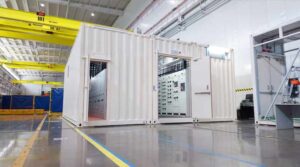
A modular data center is an infrastructure solution made up of prefabricated units or standardised components that are designed to work together as a coordinated system. Depending on the project, modules may contain server racks, power distribution equipment, uninterruptible power supplies (UPS), cooling equipment, fire protection systems, monitoring systems or supporting enclosures. Some solutions are delivered as self-contained units, while others comprise multiple modules integrated into an existing building or purpose-built campus.
The defining feature is not simply that a data center uses containers. Rather, it is that the design standardises major infrastructure elements so that they can be manufactured, tested, transported, installed and expanded according to a repeatable process. This approach can reduce the amount of construction and system integration required at the deployment site. This is particularly relevant when organisations require computing capacity quickly, operate in locations with limited construction resources or anticipate demand growth in stages rather than all at once.
Modular data centers are used in telecommunications, edge computing, industrial automation, enterprise IT, disaster recovery, and selected cloud infrastructure applications. However, their suitability depends on more than just installation speed; electrical capacity, cooling performance, environmental conditions, physical security, maintainability, and the consequences of downtime must all be evaluated before a configuration is selected.
What Is a Non-Modular Data Center?
A non-modular data center is usually a conventional facility where the building, electrical infrastructure, cooling plant, server rooms, and supporting systems are designed and constructed as a bespoke project for a specific site. Facilities may include raised floors, dedicated mechanical rooms, generators, uninterruptible power supply (UPS) systems, redundant distribution paths and sophisticated building management systems. These elements are coordinated around the site’s physical characteristics, the anticipated IT load, the operating model and future expansion plans.
This approach provides considerable freedom to tailor the facility to complex technical requirements. For instance, a large enterprise data center may require multiple electrical distribution paths, specialised cooling arrangements, strict security zones and dedicated spaces for equipment replacement. A purpose-built facility can accommodate these requirements without being constrained by the dimensions and interfaces of a standardised module.
However, conventional construction can involve lengthy design coordination, permitting, civil works, utility upgrades and on-site installation. Expansion may also necessitate significant modifications to existing electrical and mechanical systems. While these challenges do not make non-modular facilities inherently inefficient, they do mean that project planning, construction sequencing, and future capacity forecasting play a significant role in their overall cost and delivery schedule.
Key Differences Between Modular and Non-Modular Data Centers
Although both designs can support enterprise workloads and mission-critical computing, they differ in how infrastructure is delivered, expanded, and managed. The most important distinction is the balance between standardized deployment and site-specific engineering, rather than whether one approach is inherently more advanced.
Deployment Speed and Construction Process
A modular data center can reduce deployment time because its major components are manufactured and assembled in a controlled factory environment. Electrical distribution systems, cooling equipment, racks, and monitoring systems can be integrated and tested before shipment, enabling site preparation and module production to proceed in parallel. Once the site is ready, installation will primarily involve positioning the modules, connecting utilities and networks, and completing commissioning. However, actual lead times still depend on equipment availability, permits, grid connections, transportation, and the complexity of the project.
In contrast, a non-modular facility typically requires more sequential coordination among architects, civil engineers, electrical contractors, mechanical specialists, and IT teams. Construction may include foundations, structural work, mechanical and electrical installation, and extensive system-level testing. For a large campus with complicated redundancy requirements, this process can take a considerable amount of time. However, an existing building with the necessary power and cooling capacity can be upgraded more quickly than a new modular facility requiring extensive site development.
Scalability and Expansion Flexibility
One of the strongest arguments for a modular data center is scalability. Rather than funding the entire anticipated build-out upfront, organisations can deploy an initial amount of capacity and add modules as demand increases. This staged approach helps to align capital spending with actual computing demand, which is particularly beneficial for telecommunications networks, distributed applications and industrial sites, where workload growth is difficult to predict.
While conventional data centers can also expand in phases, this may require additional floor space, new electrical distribution equipment, cooling plant upgrades and modifications to existing infrastructure. Nevertheless, a purpose-built facility may offer greater freedom to accommodate irregular layouts, specialised equipment, and complex power or cooling configurations. The practical limit of either approach is determined by the available utility capacity, the available site space, the interconnection design, and the ability to perform maintenance without disrupting operations.
Initial Investment and Total Cost of Ownership
When comparing the costs of modular and non-modular data centers, it is important to consider the entire lifecycle rather than just the purchase price. Modular designs can reduce the need for on-site labour, construction coordination and commissioning, while standardised manufacturing can improve cost predictability. They can also mitigate the financial risk of building unused capacity before it is required.
However, there may be transportation, lifting, enclosure, environmental protection and integration costs associated with modular facilities. Specialised modules can also be costly when a project requires unusual power density, extreme weather protection or extensive redundancy. Conventional facilities may benefit from economies of scale when a large, long-term computing requirement justifies a purpose-built campus, despite the substantial initial investment.
A sound financial assessment should consider capital and operating expenditure, energy consumption, maintenance and replacement cycles, financing costs, and the business impact of delayed deployment. The right choice delivers the required capacity and service availability at an acceptable lifecycle cost.
Reliability, Redundancy, and Maintenance
Neither modular nor non-modular construction automatically ensures greater reliability. Rather, reliability depends on the complete infrastructure design, which includes power paths, uninterruptible power supply (UPS) systems, generators, cooling capacity, controls, fire protection, component quality, and operating procedures. Rather than simply classifying facilities by construction method, the Uptime Institute Tier framework evaluates infrastructure performance according to defined criteria for redundancy, maintainability, and fault tolerance.
In a modular environment, standardised components can simplify maintenance planning and facilitate the replication of tested configurations across multiple sites. However, shared utility connections, common cooling systems or poorly isolated control systems can create failure points that affect several modules simultaneously. A conventional facility can provide highly redundant electrical and mechanical systems, but its complexity may increase the burden of documentation, testing, and ongoing maintenance.
For either approach, the design team should identify single points of failure, define maintenance procedures, test failover behaviour, and verify that actual operating conditions match the intended redundancy strategy. Where downtime has a significant financial or safety impact, independent engineering reviews and integrated systems testing are particularly important.
Cooling, Energy Efficiency, and Environmental Control
The cooling requirements depend primarily on the IT power density, the configuration of the equipment, the local climate, and the heat rejection strategy. Modular data centers can use integrated air cooling, in-row cooling, liquid cooling, or other configurations, provided the design supports them. Factory integration can help to coordinate airflow paths and mechanical components; however, compact enclosures may limit the ability to make future changes to equipment if thermal capacity has not been planned carefully.
Non-modular facilities often offer greater flexibility in designing large chilled-water plants, separate mechanical spaces, economiser systems and specialised cooling arrangements. This flexibility can be valuable for high-density computing and facilities expecting multiple generations of server hardware. However, a larger building does not automatically consume less energy. Poorly controlled airflow, oversized equipment and inefficient part-load operation can all undermine performance.
The fifth edition of ASHRAE’s Thermal Guidelines for Data Processing Environments provides technical guidance on managing the thermal conditions of IT equipment. In practice, buyers should compare the expected power usage effectiveness (PUE), cooling redundancy, environmental operating limits and, where relevant, water consumption, as well as performance at the anticipated IT load, rather than relying on generic efficiency claims.
Site Requirements, Transportation, and Deployment Constraints
Modular facilities can be useful in remote industrial areas, for telecommunications purposes, for temporary operations, and in places where conventional construction resources are limited. However, prefabrication does not eliminate the need for on-site requirements. Suitable foundations, drainage, access control, power, network connectivity, cooling clearances, and compliance with local building and fire codes are still required.
Transportation is another important consideration in the planning process, as module dimensions, weight, lifting points, route restrictions, and delivery access can affect installation costs and schedules. For projects that use containerised logistics, we evaluate transportation and equipment-container options from CIMC TLC|RYC|XLC as part of the broader supply-chain planning process. In this process, we treat data center enclosures and IT infrastructure as separate technical requirements.
While conventional facilities avoid some module-size and road-transport limitations, they still depend on construction access, material delivery, utility connections, and local approvals. Consequently, site feasibility should be assessed before committing to either delivery model.
Modular vs. Non-Modular Data Centers: Comparison Table
The following table summarizes the key differences for infrastructure planners, IT managers, and organizations evaluating a new deployment.
Comparison Factor | Modular Data Center | Non-Modular Data Center |
Construction method | Prefabricated modules assembled and integrated | Predominantly site-specific construction |
Deployment schedule | Often faster with parallel factory production and site preparation | Often longer for a new-build facility |
Initial investment | Supports phased capacity investment | May require greater upfront investment for a complete facility |
Scalability | Capacity can be added through compatible modules | Expansion may require building and infrastructure modifications |
Design flexibility | High within standardized configurations | Generally greater freedom for bespoke layouts |
| Cooling design | Integrated systems configured for module requirements | Broad flexibility in mechanical plant and cooling architecture |
| Reliability | Depends on redundancy, integration, and operations | Depends on redundancy, integration, and operations |
| Maintenance | Standardized components may simplify servicing | Site-specific systems may require more specialized coordination |
| Transportation | Module size, weight, and access can be significant constraints | More materials can be delivered and installed separately |
| Best-fit applications | Edge computing, remote sites, phased deployments | Large campuses, specialized environments, long-term custom facilities |
These are general tendencies, not universal outcomes. A modular project with complex site works may take longer than an upgrade to an existing conventional facility, and a conventional data center can achieve the same availability objectives as a modular one when both meet the relevant engineering requirements.
Advantages and Disadvantages of Modular Data Centers
A modular data center is most attractive when deployment speed, repeatability, and staged investment are important business priorities. Its limitations become more apparent when projects involve unusual physical constraints, highly customized infrastructure, or complex integration with an existing facility.
Main Advantages
- Faster deployment: Factory-based assembly and parallel site preparation can reduce the time between project approval and operational readiness, provided that power, permits, and networking are available.
- Incremental capacity planning: Organizations can add computing capacity in stages, helping them avoid committing to infrastructure that may remain unused for years.
- Standardized quality control: Repeated configurations and factory testing can make installation more consistent and simplify commissioning across multiple locations.
- Repeatable operations: Deployments using common components can simplify spare-parts management, staff training, maintenance procedures, and technical documentation.
- Remote-site suitability: Prefabricated systems can reduce the amount of specialized construction work required at locations with limited local resources.
Main Disadvantages
- Transportation constraints: Large or heavy modules can require specialized vehicles, lifting equipment, and carefully planned delivery routes.
- Limited customization: Standardized dimensions and interfaces may complicate unusual layouts or future upgrades that exceed the original design assumptions.
- Site infrastructure dependency: Prefabrication cannot compensate for inadequate grid capacity, poor network connectivity, insufficient drainage, or unsuitable foundations.
- Vendor integration risks: Modules from different suppliers may have incompatible controls, monitoring interfaces, or maintenance requirements unless integration is specified clearly.
- Expansion dependencies: Additional modules still require sufficient electrical, cooling, network, and physical capacity, so expansion is not necessarily plug-and-play.
How to Choose the Right Data Center Architecture?
The decision should begin with operational requirements rather than a preference for a particular construction method. Organizations should define their target IT load, expected growth, availability objectives, site conditions, and deployment deadline before comparing proposals. The following criteria can help guide the selection.
Choose a modular data center when:
- Computing capacity must be deployed quickly at one or more locations.
- Demand is expected to increase gradually, and investment needs to follow actual utilization.
- The application requires a repeatable design across distributed or remote sites.
- Standardized maintenance and component replacement are operational priorities.
- Site conditions support the transportation, installation, and connection of prefabricated modules.
Choose a non-modular data center when:
- The project requires highly customized building layouts or specialized mechanical and electrical infrastructure.
- A large, long-term computing requirement justifies a purpose-built facility.
- The organization needs extensive freedom to integrate existing infrastructure or accommodate unusual equipment.
- Local site conditions make module delivery and installation impractical.
- Long-term campus planning, physical expansion, and complex facility integration outweigh the benefits of standardized deployment.
It is also worth considering a hybrid architecture. For instance, a company could run a traditional central data center while deploying modular units closer to factories, telecommunications networks, or regional users. This setup combines centralised computing resources with distributed capacity, which is ideal for applications requiring low latency or local processing.
Before making a final decision, request a lifecycle cost model, detailed power and cooling designs, commissioning documentation, information on expansion limits, and a maintenance plan. If a particular level of availability is required, verify the actual infrastructure design against the applicable performance criteria, rather than assuming that a product described as modular or prefabricated automatically meets a specific reliability standard.
Frequently Asked Questions About Modular Data Centers
- What is the main difference between modular and non-modular data centers?
A modular data center uses prefabricated, standardized units that can be installed and expanded in stages, whereas a non-modular data center is generally built as a site-specific facility. The main trade-off is between standardized deployment and the flexibility of conventional construction.
- Is a modular data center cheaper than a traditional data center?
A modular data center can reduce construction labor, shorten deployment, and limit upfront spending through phased expansion. However, total cost depends on transportation, equipment specifications, redundancy, energy consumption, and long-term maintenance.
- How long does it take to deploy a modular data center?
A modular deployment can be faster than constructing a new conventional facility because manufacturing and site preparation can occur simultaneously. The actual schedule depends on capacity, customization, permitting, utility connections, transportation, and commissioning requirements.
- Are modular data centers reliable?
Yes, modular data centers can support demanding workloads when their power, cooling, redundancy, and monitoring systems are appropriately engineered and tested. Reliability depends on the complete design and operating procedures, not simply on the use of prefabricated modules.
- Can modular data centers support AI and high-performance computing?
Yes, provided that the design supports the required rack power density, cooling capacity, electrical distribution, and network performance. High-density AI deployments may require liquid cooling, specialized power infrastructure, and careful planning for future equipment upgrades.
- Can a modular data center be expanded after installation?
Yes, many modular designs support expansion by adding compatible units as computing demand grows. Successful expansion still depends on available site space, utility capacity, cooling infrastructure, network connections, and compatibility with the original system.
Conclusion
The key differences between modular and non-modular data centers lie in their construction methodology, deployment speed, scalability, customisation, and lifecycle costs. Modular designs are often favoured for rapid deployment, distributed computing and phased investment, whereas conventional facilities are better suited to large-scale projects requiring extensive customisation and integrated infrastructure.
Neither architecture is universally superior. The most appropriate choice depends on an organisation’s workload, growth forecasts, reliability targets, site conditions and long-term operating strategy. By comparing complete lifecycle costs and verifying power, cooling, maintainability and redundancy requirements, decision-makers can select an architecture that meets current and future computing needs and business objectives.