


 EN
EN  RU
RU 
In recent years, the global energy structure has accelerated its transformation to renewable energy, and the installed capacity of clean energy, such as wind and solar energy, has grown rapidly. However, these energy sources have problems of intermittency and volatility, so energy storage technology has become a key breakthrough in the energy field. Among the many energy storage solutions, energy storage containers are reshaping the pattern of energy storage with their flexible and efficient characteristics, and have become the focus of attention in the energy industry.
The birth background and core concepts of energy storage containers
Traditional energy storage systems often have problems such as complex installation, long construction period, and high site requirements. For example, early large-scale energy storage power stations require a large amount of equipment installation and commissioning on site, which may take several years from planning to commissioning, which is costly and inflexible. To solve these problems, energy storage containers came into being.
Energy storage containers, also known as PCS containers or battery containers, integrate a complete set of energy storage systems in a standard container. This seemingly ordinary box is a highly integrated energy management center, which contains core components such as battery cells, battery management systems (BMS), energy storage converters (PCS), fire protection systems, heating, ventilation, and air conditioning (HVAC), and DC panels. This integrated design breaks the limitations of traditional energy storage models, realizes modular production and convenient transportation of energy storage equipment, and greatly improves the deployment efficiency of energy storage systems.

Analysis of the internal structure of energy storage containers
- Battery cells: the foundation of energy storage
The battery cell is the core of the energy storage container and directly determines the capacity and performance of the energy storage system. Currently, mainstream energy storage containers on the market mostly use lithium batteries. Taking a certain project as an example, a 20-foot energy storage container may have hundreds of lithium battery cells built in. These cells are connected in series and parallel in a carefully designed manner to form battery modules, and then multiple battery modules form a complete battery pack. Lithium batteries have the advantages of high energy density and excellent charging and discharging efficiency, which can effectively meet the energy storage needs of different scenarios. However, lithium batteries have high requirements for the use environment, which requires other components to work together to ensure their stable operation. - Battery Management System (BMS): Guardian of Batteries
BMS can be called the “smart butler” of batteries. In actual operation, BMS monitors the voltage, current, temperature, and other parameters of each battery cell in real time. There was once an energy storage project. Due to a sudden rise in the external ambient temperature, some battery cells showed signs of overheating. The BMS detected the abnormality in time, quickly adjusted the charging and discharging strategy, and linked the HVAC system to strengthen heat dissipation, avoiding battery performance degradation and even safety accidents. Through precise data analysis and control, the BMS can not only ensure the voltage balance between battery modules but also detect and handle potential faults in time, extending the battery life. - Energy Storage Converter (PCS): The Hub of Power Conversion
PCS is responsible for realizing the bidirectional conversion between AC and DC. During the charging stage, it converts the AC output of the power grid or renewable energy power generation equipment into DC suitable for battery charging; during discharge, it converts the DC power of the battery into AC that meets the requirements of the power grid. In a wind, solar and storage integrated project, when there is sufficient solar energy during the day, the PCS converts the AC generated by the photovoltaic power station into DC and stores it in the battery; at night when the power consumption is peak, the DC power in the battery is converted into AC and incorporated into the power grid, effectively alleviating the power supply pressure. In addition, PCS also has functions such as power regulation and power quality optimization to ensure stable and reliable output power. - Fire protection system: a safe and solid line
Energy storage systems have certain fire risks, so fire protection systems are crucial. The fire protection system of energy storage containers usually consists of smoke sensors, temperature sensors, and fire extinguishing devices. When the sensor detects smoke and temperature abnormalities, it will immediately sound an alarm and automatically start the fire extinguishing device. A certain energy storage power station once caused local high temperatures due to an internal battery short circuit. The fire protection system detected the abnormality in just a few seconds and quickly released fire extinguishing gas to control the fire in its infancy, avoiding greater losses. Some advanced energy storage containers are also equipped with early fire warning technology to further improve the level of safety protection. - Heating, ventilation, and air conditioning (HVAC) system: a guarantee for stable operation
Battery performance is significantly affected by temperature. The role of the HVAC system is to create a suitable working environment for the battery. In the hot summer, the HVAC system reduces the temperature inside the box through cooling; in the cold winter, it maintains a stable temperature through heating. In a certain energy storage project in the northwest of my country, the local winter temperature is as low as -20℃. The HVAC system continues to work to keep the temperature inside the box at around 25℃, ensuring the normal charging and discharging of the battery. At the same time, the HVAC system can also maintain air circulation in the box and discharge harmful gases generated by battery operation. - DC panel: the control center of the circuit
The DC panel is the control core of the internal circuit of the energy storage container. It connects the battery pack, PCS, and other equipment to realize the distribution and control of electric energy. Various switches, fuses, and monitoring instruments are set on the panel. The staff can use the DC panel to switch the circuit on and off, monitor the current and voltage in real time, and troubleshoot faults. Its overload protection and short-circuit protection functions can quickly cut off the power supply when the circuit is abnormal to ensure the safety of equipment and personnel.

Significant advantages of energy storage containers
- Integrated design, convenient transportation, and installation
The highly integrated design of energy storage containers is a highlight. In the past, the construction of energy storage power stations required a large amount of equipment installation on site, which was time-consuming and labor-intensive. After the energy storage container is assembled in the factory, it can be directly transported to the project site by sea, land, air, or rail. After arriving at the destination, it can be quickly put into use with simple lifting and circuit connection. In a certain island microgrid project, due to its remote geographical location, traditional energy storage equipment was difficult to transport and install. However, after using energy storage containers, it took only one week from transportation to commissioning, greatly shortening the project cycle. - Adapt to harsh environments and strong reliability
The shell of the energy storage container is made of high-strength weathering steel, which has excellent corrosion and impact resistance. In coastal areas, high salt fog environments are prone to corroding ordinary metal materials, but the weathering steel shell of the energy storage container can effectively resist salt fog erosion; in desert areas, it can also withstand the test of high temperature and wind, and sand. At the same time, its protection level reaches IP54 or above, which can prevent dust and water from entering, and can operate stably in various complex environments. - Excellent safety performance and comprehensive protection
In addition to the fire protection system, the energy storage container also has many safeguards in terms of electrical and structural safety. Electrically, the perfect grounding system, insulation protection, and leakage protection devices reduce the risk of electrical accidents; BMS monitors and protects against abnormal conditions such as battery overcharging and over-discharging in real time. Structurally, its frame has been optimized and designed to be strong and stable. Some products are also equipped with earthquake-resistant devices to withstand natural disasters. - Customized services to meet diverse needs
Different energy projects have different requirements for energy storage systems, and energy storage containers are highly customizable. In terms of capacity, a variety of specifications can be provided, ranging from 0.5MWH to 2.5MWH; in terms of functions, in addition to standard configurations, energy management systems (EMS) and intelligent monitoring systems can also be integrated. For example, data centers have extremely high requirements for power supply stability, and energy storage containers equipped with advanced EMS can be customized for them to achieve precise energy management; plateau areas have high requirements for equipment cold resistance, so insulation design can be strengthened in a targeted manner. - Modular design, convenient maintenance, and upgrade
The energy storage container adopts a modular design, and internal components such as battery modules and PCS modules can be disassembled and replaced independently. When a component fails, there is no need to conduct a large-scale overhaul of the entire system. Only the faulty module needs to be replaced, which greatly shortens the maintenance time. With the development of technology, users can also easily upgrade components to improve system performance and reduce long-term use costs.
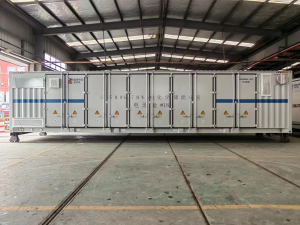
Types and technical parameters of energy storage containers
- 10′ energy storage container
The external dimensions of the 10′ energy storage container are 2991 (L) x 2438 (W) x 2896 (H) mm, the internal dimensions are 2645 (L) x 2175 (W) x 2590 (H) mm, the deadweight is 3000kg, the maximum total weight is 7160kg, the protection level is IP54, and the power is 0.5 – 1MWH. It is suitable for small projects such as community energy storage and backup power supply for small commercial places. Its small size makes it easy to install and use in places with limited space. - 20′ energy storage container
The external dimensions of the 20′ energy storage container are 6058 (L) x 2438 (W) x 2896 (H) mm, the internal dimensions are 5340 (L) x 2188 (W) x 2590 (H) mm, the deadweight is 4500kg, the maximum gross weight is 25980kg, and the power is 1 – 1.5MWH. Compared with the 10′ container, it has a larger internal space and a stronger carrying capacity, and is suitable for projects such as medium-sized commercial building energy storage and small distributed power stations. - 40′ energy storage container
The external dimensions of the 40′ energy storage container are 12192 (L) x 2438 (W) x 2896 (H) mm, the internal dimensions are 11880 (L) x 2188 (W) x 2590 (H) mm, the deadweight is 6950kg, the maximum total weight is 23530kg, and the power is 1.5 – 2MWH. It is suitable for large-scale projects such as large energy storage power stations and industrial park energy storage, and can store more electricity to meet high-power electricity demand. - 45′ energy storage container
The external dimensions of the 45′ energy storage container are 13716 (L) x 2438 (W) x 2896 (H) mm, the internal dimensions are 15840 (L) x 2188 (W) x 2590 (H) mm, the deadweight is 8700kg, the maximum gross weight is 21780kg, and the power is 2 – 2.5MWH. It is a relatively large energy storage container, mainly used in super-large energy storage projects, such as regional power grid peak regulation, supporting energy storage for large renewable energy bases, etc.
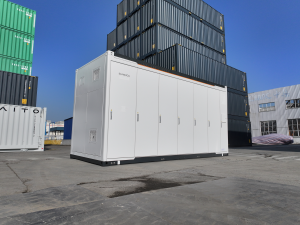
Multiple application scenarios of energy storage containers
- Peak and frequency regulation of the power system
In the power system, the power load changes all the time, with power shortage during peak hours during the day and excess power during valley hours at night. Energy storage containers can be charged during valley hours and discharged during peak hours to achieve “peak shaving and valley filling”. At the same time, when the grid frequency fluctuates, it can quickly adjust the charging and discharging power, participate in frequency regulation services, and ensure the stable operation of the grid. - Renewable energy consumption
There is a phenomenon of wind and solar energy abandonment in renewable energy sources such as wind power and solar energy. Energy storage containers can store excess electricity to avoid waste. In wind farms, electricity is stored when the wind speed is high and released when the wind speed is low to achieve smooth wind energy output; in solar power stations, the intermittent problem of photovoltaic power generation is solved to improve the utilization rate of renewable energy. - Backup power supply and emergency power supply
Hospitals, data centers, communication base stations, and other places have extremely high requirements for power supply reliability. Energy storage containers can be used as backup power supplies to quickly supply power when the grid is out of power. When natural disasters occur and the grid is damaged, it can also be used as an emergency power supply to provide power support to the affected areas. - Energy saving and consumption reduction in industrial parks and commercial buildings
Industrial parks and commercial buildings can use energy storage containers to charge during off-peak hours and discharge during peak hours to reduce electricity costs. It can also be combined with distributed energy systems to achieve energy self-sufficiency and improve energy efficiency. - Off-grid microgrid system
In remote islands, mountainous areas, rural areas, and other areas, energy storage containers can be combined with distributed power generation equipment to build off-grid microgrids to provide stable electricity to the local area and improve living and economic development conditions.
Service guarantee system for energy storage containers
- Pre-sales service: professional planning and customization
In the pre-sales stage, the professional consultant team provides comprehensive consulting services based on customer needs, application scenarios, and budgets, and analyzes project feasibility and investment returns. At the same time, tailor-made energy storage solutions for customers, from capacity configuration to functional design, to ensure that the solution meet actual needs. - After-sales service: rapid response and long-term maintenance
In terms of after-sales service, a 1-year warranty for structure, a 3-year warranty for paint, and a 5-year warranty for decals are provided. Establish a quick response mechanism. After the customer feedback on the problem, the after-sales staff will give a solution within 24 hours, and arrange personnel to repair the emergency fault on site as soon as possible. Regularly visit customers to collect opinions and improve services. - Delivery and transportation: efficient and safe delivery
Delivery within 60 days after the order is confirmed, and provide multiple modes of transportation such as ocean, rail, and road. Cooperate with professional logistics companies to properly package and protect the containers, track the transportation progress in real time, and ensure the safety and timely delivery of products.
Energy storage containers play an important role in the field of energy storage, with their advantages. With the continuous advancement of technology and the gradual reduction of costs, its application prospects will be broader, and it is expected to contribute more to global energy transformation and sustainable development. If you are interested in energy storage containers or have related project needs, please contact us to explore the infinite possibilities of energy storage together.
CIMC TLC|RYC|XLC is a leading manufacturer of prefab electrical houses and various other standard and special logistics equipment. With years of experience in the industry, it focuses on the design, production, and distribution of high-quality innovative products that meet the specific needs of customers.
If you need high-quality and innovative logistics equipment, including refrigerated containers, cold chain equipment, containerized equipment integration, modular buildings, etc., CIMC TLC|RYC|XLC is your best choice. We welcome inquiries from customers all over the world and look forward to the opportunity to cooperate with you.