


 EN
EN  RU
RU 
Quick Answer:
A prefabricated data centre is a modular, factory-built solution that integrates critical infrastructure, including IT racks, power distribution, cooling systems, fire protection, monitoring, and security, into pre-engineered modules. These modules are transported to the deployment site for rapid installation.
According to research by the Uptime Institute and the International Data Corporation, Prefab Container Office can significantly reduce deployment timelines, improve quality control, and provide scalable infrastructure for cloud computing, artificial intelligence (AI), edge computing, telecommunications, and enterprise digital transformation projects.
Introduction: Why Prefab Data Centers Are Reshaping Modern Digital Infrastructure
The digital economy is growing at an unprecedented pace. Artificial intelligence, cloud computing, 5G networks, the Industrial Internet of Things (IIoT), autonomous systems, and edge computing are driving demand for computing power across nearly every industry. While still important, traditional brick-and-mortar data centres often struggle to meet the speed, scalability, and flexibility requirements of modern organisations.
This has accelerated the adoption of prefabricated data centres, which are sometimes referred to as modular, containerised, or prefabricated IT infrastructure modules. Unlike conventional facilities, which require extensive on-site construction, prefab data centres are engineered and assembled in a controlled factory environment before being delivered as ready-to-deploy units.
This concept is similar to modular construction in the building industry. Rather than constructing every component on-site, critical infrastructure is manufactured, integrated, tested, and commissioned before shipment. As a result, deployment cycles can be reduced from years to months or even weeks.
Hyperscale cloud providers, telecommunications companies, government agencies, financial institutions, healthcare organisations, and industrial enterprises are increasingly turning to prefab solutions to meet their rapidly changing infrastructure requirements.
Understanding the Definition of a Prefab Data Center
A prefabricated data centre is a pre-engineered, factory-integrated facility designed to house computing infrastructure. The solution typically arrives as one or more modules that include:
- IT cabinets and server racks
- Power distribution systems
- UPS systems
- Backup power infrastructure
- Cooling systems
- Fire suppression systems
- Environmental monitoring systems
- Physical security systems
- Network infrastructure
- DCIM platforms
Unlike traditional facilities, which require the separate installation and integration of each subsystem, prefab data centres are delivered as complete solutions.
The primary objective is to shorten deployment schedules while maintaining consistent quality, efficiency, and reliability.
How a Prefab Data Center Works?
The lifecycle of a prefabricated data centre typically comprises five stages:
Design and engineering
Engineers determine:
- IT load requirements
- Rack density
- Cooling strategy
- Redundancy level
- Future expansion needs
- Environmental conditions
The design is standardised while remaining customisable for specific workloads.
Factory manufacturing
Modules are manufactured in controlled production environments. This process eliminates many of the risks associated with weather delays, labour shortages, and construction variability.
Factory integration testing
Before shipment, systems undergo comprehensive testing:
- Electrical testing
- Mechanical testing
- Cooling validation
- Fire suppression testing
- Monitoring verification
- Load simulations
This approach minimises deployment risks.
Transportation
Completed modules are transported by truck, rail, or ship.
Containerised solutions are especially popular because they simplify logistics and international deployment.
Site installation
Once delivered, the modules are connected to:
- Utility power
- Network connectivity
- Fuel systems
- Water systems (if required)
The facility can often become operational within days or weeks.
Main Components of a Prefab Data Center
IT infrastructure module
The IT infrastructure module contains:
- Server racks
- Storage systems
- Network switches
- Cabling infrastructure
These modules are optimised for airflow management and operational efficiency.
Power module
Power systems commonly include:
- UPS units
- Battery systems
- Power distribution units
- Switchgear
- Generators
Reliable power architecture is one of the most critical aspects of any data centre design.
Cooling module
Cooling systems may include:
- Precision air conditioning
- In-row cooling
- Liquid cooling
- Chilled water systems
- Direct expansion systems
Cooling technology selection depends heavily on workload density.
Monitoring and control systems
Modern prefab facilities incorporate:
- DCIM software
- Environmental sensors
- Remote monitoring
- Predictive maintenance analytics
These tools improve operational visibility and efficiency
Types of Prefab Data Centers
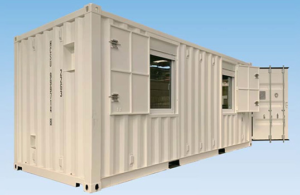
Containerised data centres
Containerised facilities use ISO shipping containers as the physical enclosure.
Advantages include:
- Rapid deployment
- Easy transportation
- High mobility
- Standardised manufacturing
These solutions are widely used in:
- Remote mining sites
- Military deployments
- Telecom networks
- Disaster recovery environments
Modular building data centres
These systems consist of larger prefabricated modules that are assembled into permanent facilities.
Benefits include:
- Greater scalability
- Higher rack capacities
- Long-term infrastructure investment
They are commonly used by:
- Hyperscale cloud providers
- Government facilities
- Enterprise campuses
Edge data centres
Edge deployments place computing resources closer to users.
Applications include:
- 5G infrastructure
- Smart cities
- Autonomous vehicles
- Industrial IoT
Prefabrication enables rapid deployment across distributed locations.
Key Advantages of Prefab Data Centers
Faster Deployment
Speed is perhaps the most significant advantage.
Deployment Comparison
Deployment Method | Typical Construction Time |
Traditional Data Center | 18-36 Months |
Modular Building Data Center | 6-12 Months |
| Prefab Data Center | 3-9 Months |
| Containerized Data Center | 4-16 Weeks |
Organizations can dramatically accelerate digital transformation initiatives.
Improved quality control
Factory manufacturing offers:
- Controlled environments
- Repeatable processes
- Standardised testing
- Reduced construction variability
This often leads to greater reliability and fewer commissioning issues.
Scalability
Prefabricated data centres support incremental growth.
Organisations can:
- Start with a small deployment
- Add modules as demand increases
- Avoid overbuilding infrastructure
This approach aligns capital expenditure with business growth.
Reduced project risk
Traditional projects often experience:
- Weather delays
- Labour shortages
- Supply chain disruptions
- Construction defects
Factory-built solutions mitigate many of these risks.
Better predictability
Prefabricated deployments typically offer:
- Fixed timelines
- Predictable costs
- Repeatable performance
These characteristics are highly attractive to enterprise decision-makers.
Prefab Data Centers vs Traditional Data Centers
Structural Differences
Feature | Prefab Data Center | Traditional Data Center |
Construction Location | Factory | Site |
Deployment Speed | Fast | Slow |
Scalability | Modular | Complex |
| Quality Control | High | Variable |
| Expansion Flexibility | Excellent | Limited |
| Initial Planning | Simplified | Extensive |
| Project Risk | Lower | Higher |
The comparison clearly demonstrates why modular infrastructure continues gaining market share globally.
The Role of Prefab Data Centers in AI Infrastructure
The rise of artificial intelligence has transformed the requirements of data centres.
AI workloads require:
- High-density computing;
- Advanced cooling;
- Massive power capacity;
- Rapid deployment.
Traditional facilities often struggle to meet these demands quickly enough.
Prefabricated data centres provide an attractive alternative, enabling organisations to deploy AI infrastructure much faster.
Many AI clusters now incorporate the following features:
- Liquid cooling systems
- High-density racks
- GPU-focused architecture
- Modular expansion capability
These features align naturally with prefab design principles.
Sustainability Benefits
Environmental responsibility is becoming a strategic priority.
Prefabricated data centres can contribute to this by:
- Reduced construction waste
- Improved energy efficiency
- Optimised cooling systems
- Lower embodied carbon
- Better resource utilisation
Factory production often generates significantly less waste than traditional construction methods.
Energy Efficiency Comparison
Metric | Traditional Facility | Modern Prefab Facility |
Construction Waste | High | Lower |
PUE Optimization | Moderate | High |
| Cooling Efficiency | Variable | Optimized |
| Resource Utilization | Moderate | High |
As sustainability regulations become stricter, these advantages are becoming increasingly valuable.
Common Applications of Prefab Data Centers
Cloud computing
Cloud providers often use modular infrastructure to meet rapidly growing demand.
Telecommunications
The expansion of 5G requires distributed computing nodes across large geographic areas.
Prefabricated solutions accelerate network deployment.
Government and defence
Government agencies value:
- Security
- Rapid deployment
- Mobility
- Reliability
Containerised data centres often support mission-critical operations.
Healthcare
Healthcare organisations use prefab facilities to support:
- Electronic medical records
- Medical imaging
- AI diagnostics
- Telemedicine
Industrial facilities
Manufacturing companies deploy edge data centres to support:
- Industrial automation
- Predictive maintenance
- Digital twins
- Smart factory initiatives
Challenges and Considerations
Although prefabricated data centres offer substantial benefits, organisations should consider the following:
Transportation constraints:
Large modules may require special logistics planning.
Site preparation
Even modular deployments require:
- Foundations
- Utility connections
- Network connectivity
Future expansion planning
Growth requirements should be incorporated into the initial design.
Regulatory compliance
Projects must comply with the following:
- Local building codes
- Electrical regulations
- Fire protection standards
- Industry certifications
How to Choose the Right Prefab Data Center Supplier?
It is crucial to select the right supplier.
Key evaluation factors include:
Engineering expertise
Look for providers with experience in:
- Data centre design
- Power systems
- Cooling technologies
- Factory integration
- Manufacturing capability
Suppliers should maintain:
- Quality management systems
- Standardised production processes
- Factory acceptance testing procedures
- Global delivery experience
- International deployment experience helps minimise logistics challenges
- Lifecycle support
Services should include:
- Design consulting
- Commissioning
- Maintenance
- Technical support
Leading modular infrastructure providers, such as CIMC TLC, RYC, and XLC, have developed integrated prefabricated data centre solutions for enterprise, telecoms, and edge computing applications. These solutions help customers to accelerate deployment while maintaining high reliability standards.
Future Trends in Prefab Data Centers
Several trends are shaping the future of the industry.
AI-ready modular infrastructure
Designed specifically for GPU-intensive workloads.
Liquid cooling integration: increasing rack densities are driving the adoption of liquid cooling technologies.
Edge computing expansion: thousands of distributed micro data centres will be required globally.
Smart operations: AI-driven monitoring and predictive maintenance are becoming standard features.
Sustainable manufacturing: future modules will prioritise:
- Recyclable materials
- Renewable energy integration
- Carbon reduction strategies
FAQ: Prefab Data Center
- What is a prefab data center?
A prefab data center is a factory-built, pre-engineered facility that integrates IT, power, cooling, monitoring, and security systems into modular units for rapid deployment.
- How is a prefab data center different from a traditional data center?
Prefab facilities are manufactured and tested in factories before shipment, while traditional data centers are built entirely on-site.
- How long does it take to deploy a prefab data center?
Deployment can range from several weeks to several months, significantly faster than traditional facilities that often require 18–36 months.
- Are prefab data centers scalable?
Yes. One of their biggest advantages is modular scalability, allowing organizations to add capacity as needed.
- Are prefab data centers suitable for AI workloads?
Absolutely. Modern prefab facilities can support high-density GPU clusters, liquid cooling systems, and AI infrastructure requirements.
- What industries use prefab data centers?
Cloud computing, telecommunications, healthcare, government, manufacturing, finance, energy, and edge computing sectors commonly deploy prefab data centers.
Conclusion
A prefabricated data centre is much more than just a shipping container filled with servers. It is a modern infrastructure strategy that brings together speed, scalability, quality control, and operational efficiency in a single deployment model. As organisations face mounting demands from AI, cloud computing, edge applications, and digital transformation initiatives, prefabricated solutions are emerging as a favoured alternative to traditional construction methods.
By reducing deployment timelines, improving reliability, and enabling flexible growth, prefabricated data centres are reshaping the future of digital infrastructure. For enterprises seeking rapid, scalable, and future-ready computing environments, prefabricated architecture is no longer just an emerging trend — it is quickly becoming the new industry standard.