



 EN
EN  RU
RU 
Quick Answer
The global market for containerised energy storage systems is expanding rapidly due to the increasing demand for the integration of renewable energy, grid stabilisation, industrial backup power, and large-scale battery energy storage systems (BESS).
According to the International Energy Agency and recent energy storage market analyses, modern energy container systems are becoming critical components of the infrastructure because they provide scalable, modular, and transportable energy storage solutions that are highly integrated and capable of supporting decarbonisation and grid flexibility worldwide.
Further industry research shows that the leading manufacturers of energy containers are differentiated by their thermal safety engineering, battery integration capability, intelligent energy management systems, fire suppression technology, manufacturing scale, and compliance with standards such as UL 9540A and NFPA 855.
Why Energy Container Companies Have Become Essential to the Global Energy Transition?
Over the past decade, the global energy industry has undergone one of the most significant technological transformations in modern industrial history. The capacity of renewable energy sources, such as solar and wind power, microgrids, and distributed power systems, has expanded rapidly, while electrification has accelerated in sectors such as transportation, manufacturing, telecommunications, mining, marine engineering, and utility infrastructure. As the generation of renewable energy continues to increase worldwide, energy storage has emerged as one of the most critical technologies for ensuring grid reliability, load balancing, and energy security. At the heart of this transformation is the modern energy container industry.
A modern energy container company is much more than just a manufacturer of modified steel enclosures. Today’s leading companies design and produce highly engineered, integrated systems combining battery modules, thermal management systems, intelligent controls, power conversion systems, fire suppression technology, HVAC infrastructure, gas detection systems, safety systems, and remote monitoring platforms in one scalable, containerised solution. These energy storage containers are the backbone of utility-scale battery energy storage systems (BESS), renewable integration projects, industrial backup power infrastructure, electric vehicle (EV) charging networks, and commercial energy management systems.
Traditional power infrastructure was built around centralised fossil fuel generation, which has relatively stable output characteristics. However, renewable energy fundamentally changes this dynamic, as solar and wind generation are intermittent and weather-dependent. This variability poses significant challenges to grid operators seeking to maintain power stability, frequency regulation, and energy balancing. Energy storage containers solve this problem by storing excess renewable electricity during periods of high generation and discharging it during periods of peak demand or generation shortfall.
As the energy storage industry matures, the role of specialised energy container manufacturers is becoming increasingly important. These companies are responsible for not only mechanical fabrication, but also system integration, thermal safety engineering, fire protection design, transportation optimisation, electrical integration, and digital energy management architecture. The increasing complexity of energy storage systems means that container quality directly affects the following:
- Battery lifespan
- Operational reliability
- Thermal stability
- Fire safety
- Maintenance efficiency
- Project scalability
- Transportation flexibility
- Environmental durability
The importance of advanced container engineering has increased further as the energy density of lithium-ion batteries continues to rise. High-density battery systems present significant thermal management and safety challenges that cannot be adequately addressed by ordinary industrial enclosures. Modern energy containers, therefore integrate sophisticated safety systems designed to mitigate the following:
- Thermal runaway
- Gas accumulation
- Fire propagation
- Moisture intrusion
- Overheating
- Electrical isolation failures
Leading manufacturers increasingly compete based on the following:
- UL certification capability
- Integrated fire suppression systems
- Intelligent monitoring
- Liquid cooling technology
- Modular ESS architecture
- Energy efficiency
- AI-assisted diagnostics
- Global deployment support
Our companies, CIMC, TLC, RYC, and XLC, have become increasingly recognised within the containerised energy storage industry for their expertise in engineered ESS container manufacturing, modular deployment systems, and industrial-grade energy storage integration.
The rapid expansion of renewable infrastructure, combined with rising electricity demand and grid modernisation initiatives, means that energy container companies will continue to play a foundational role in the future global energy economy.
What Is an Energy Container Company?
An energy container company is a manufacturer or integrated engineering provider that designs, produces, and supplies containerised energy storage systems for industrial, commercial, utility-scale, and renewable energy applications.
Unlike ordinary container manufacturers, energy container companies specialise in creating advanced enclosures specifically engineered for lithium-ion battery systems, Battery Energy Storage Systems (BESS), hybrid renewable systems, microgrids, telecom backup systems, off-grid power infrastructure, EV charging stations, and industrial energy management.
Modern energy containers are typically based on ISO container structures, but undergo extensive engineering modifications to support energy storage functionality and safety compliance.
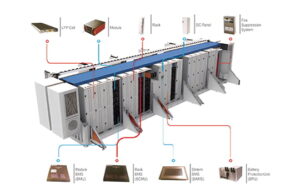
They commonly integrate the following:
- Battery racks
- HVAC cooling systems
- Thermal insulation
- Fire suppression systems
- Battery Management Systems (BMS)
- Power Conversion Systems (PCS)
- Transformers
- EMS platforms
- Intelligent monitoring systems
- Ventilation systems
- Gas detection sensors
- Emergency shutdown systems
The best energy container manufacturers provide complete system engineering rather than simple enclosure fabrication.
What Makes a Top Energy Container Manufacturer?
Not all energy container companies operate at the same technological level. The best manufacturers stand out thanks to their engineering expertise, safety performance, production scalability, and system integration capability.
Advanced thermal management
Thermal stability is one of the most important factors in lithium battery safety and operational reliability.
Leading energy container companies integrate the following:
- Precision HVAC systems
- Liquid cooling technology
- Airflow optimisation
- Thermal zoning
- Intelligent temperature monitoring
Proper thermal management directly improves the following:
- Battery lifespan
- Charging efficiency
- System safety
- Cycle stability
As energy density increases, thermal engineering becomes increasingly critical.
Fire Protection Engineering
Thermal runaway remains one of the largest challenges in utility-scale energy storage systems.
Top manufacturers, therefore, integrate the following:
- Aerosol suppression
- Water mist systems
- Clean agent systems
- Gas suppression technology
- Fire compartmentalisation
- Explosion venting
Compliance with standards such as:
UL 9540A, NFPA 855, and IEC ESS regulations has become increasingly important for global project deployment.
Intelligent Energy Management
Modern energy containers increasingly incorporate the following technologies:
- AI diagnostics
- Remote monitoring
- Predictive maintenance
- Cloud analytics
- Digital twin systems
These technologies improve operational visibility and reduce maintenance risk.
Structural engineering
Energy containers must be able to withstand transportation vibration, seismic activity, extreme temperatures, corrosion exposure, and long-term outdoor deployment. The best manufacturers, therefore use reinforced steel structures and advanced corrosion protection systems.
Top Energy Container Companies in the Global Market
The global energy storage industry includes a growing number of specialized container manufacturers and integrated ESS solution providers. Several companies have emerged as major players due to their manufacturing scale, engineering capability, safety integration, and renewable energy expertise.
The global energy storage industry comprises an increasing number of specialised container manufacturers and integrated energy storage system (ESS) solution providers. Several companies have emerged as major players thanks to their manufacturing scale, engineering capability, safety integration, and expertise in renewable energy.
CIMC TLC
CIMC TLC is widely recognised for its expertise in specialised container engineering and advanced energy storage container manufacturing. Leveraging its extensive experience in container fabrication and industrial engineering, CIMC TLC provides integrated ESS container solutions designed for utility-scale renewable energy systems, industrial energy storage, and large-scale BESS deployments.
CIMC TLC’s strengths include large-scale manufacturing capability, modular ESS integration, thermal safety engineering, high-durability container structures, and customized container solutions.
The company is increasingly focusing on renewable integration, grid-scale storage, intelligent energy systems, and high-density battery storage infrastructure.
RYC
RYC has become increasingly active in the energy storage sector through its focus on containerised ESS infrastructure and modular energy solutions. RYC supports industrial and renewable applications requiring scalable battery container systems that can operate under demanding environmental conditions.
RYC’s energy storage systems commonly emphasise environmental durability, modular deployment, efficient thermal control, integrated monitoring systems, and industrial-grade structural reliability.
The company’s container solutions are increasingly used in renewable power projects, telecom infrastructure, industrial backup systems, and distributed energy applications.
XLC
XLC is another increasingly recognized participant in the global energy container market. The company focuses on integrated battery storage infrastructure designed for commercial and utility-scale energy systems.
XLC container systems commonly integrate:
- Battery racks
- Intelligent cooling
- Fire suppression
- Electrical integration
- Smart monitoring platforms
The company continues expanding within the rapidly growing global ESS sector.
Comparison of Leading Energy Container Companies
Company | Core Strength | Main Applications | Key Advantages |
CIMC TLC | Large-scale ESS engineering | Utility-scale BESS | Advanced manufacturing capacity |
| RYC | Modular energy systems | Industrial & renewable storage | Flexible deployment |
| XLC | Integrated battery containers | Commercial ESS systems | Intelligent system integration |
Each company operates within different segments of the growing energy storage ecosystem, and project requirements often determine the most suitable supplier.
Why Containerized Energy Storage Is Dominating the Industry?
Containerised energy storage systems have become increasingly dominant because they simultaneously solve several critical deployment challenges.
Modular scalability
Energy containers allow for rapid expansion through modular deployment.
Operators can:
increase storage capacity incrementally
simplify logistics
reduce installation complexity
accelerate project timelines
Transportation efficiency
ISO-based container systems simplify global transportation, site installation, crane handling, and deployment flexibility.
Faster project delivery
Pre-integrated containerised systems reduce on-site construction, engineering complexity, and commissioning time.
Centralised system integration
Containerised ESS systems integrate batteries, cooling systems, fire protection, electrical systems, and monitoring controls into one engineered unit.
This improves maintenance efficiency, operational consistency, and safety performance.
Key Technologies Used by Modern Energy Container Companies
Technological advances are transforming the energy container industry.
Liquid cooling systems
Liquid cooling provides improved thermal uniformity, better energy efficiency, and reduced overheating risk. This technology is becoming increasingly common in high-density battery energy storage systems (BESS) projects.
AI-assisted monitoring
Artificial intelligence is increasingly being used for:
- Predictive maintenance
- Anomaly detection
- Thermal forecasting
- Battery health diagnostics
AI-driven monitoring improves operational reliability.
Digital Twin Platforms
Digital twins allow operators to simulate battery behaviour, predict maintenance needs, and optimise energy dispatch. This technology is increasingly being used in utility-scale deployments.
Advanced fire suppression
Modern ESS containers increasingly integrate gas suppression, aerosol technology, intelligent thermal detection, and compartmentalised fire isolation to improve safety performance.
Major Industries Using Energy Containers
The versatility of containerised energy storage systems (ESS) infrastructure allows it to be deployed across numerous industries.
Renewable energy
Solar and wind projects rely heavily on battery containers for peak shifting, renewable balancing, and grid stabilisation.
Utility infrastructure
Utilities are increasingly deploying ESS containers for:
- Frequency regulation
- Backup power
- Transmission support
Data centres
Battery storage improves backup reliability, power stability, and emergency continuity.
Mining and industrial operations
Remote industrial sites use energy containers for off-grid power, diesel reduction, and hybrid energy systems.
EV Charging Infrastructure
Fast-charging networks are increasingly integrating battery containers to reduce grid strain and stabilise charging demand.
Important Factors When Choosing an Energy Container Company
Selecting the right energy container manufacturer requires evaluating multiple engineering and operational factors.
Selection Factor | Why It Matters |
Safety Certification | Ensures compliance and insurance approval |
Thermal Management | Improves battery lifespan |
Fire Protection | Reduces operational risk |
Manufacturing Capacity | Supports large-scale projects |
| Customization Capability | Meets project-specific requirements |
| Global Support | Improves maintenance and deployment |
| Integration Experience | Simplifies system compatibility |
| Structural Quality | Enhances durability |
Project developers increasingly prioritize suppliers with strong system integration expertise rather than simple fabrication capability.
Future Trends in the Energy Container Industry
The next generation of energy storage containers is likely to be smarter, safer, more energy-dense, more modular, and more autonomous.
Important future trends include solid-state battery integration, AI-driven safety systems, immersion cooling, autonomous energy optimisation, ultra-high-density energy storage systems (ESS), and carbon-neutral manufacturing.
As renewable energy sources become more widely used around the world, the need for energy storage infrastructure to maintain grid stability and energy resilience will increase.
FAQ About Energy Container Companies
- What is an energy container company?
An energy container company designs and manufactures containerized energy storage systems used for battery storage, renewable integration, and industrial power management.
- What are energy containers used for?
Energy containers are used in Battery Energy Storage Systems (BESS), renewable energy projects, telecom backup systems, microgrids, EV charging infrastructure, and utility-scale power storage.
- Why are containerized ESS systems popular?
They provide modular deployment, transportation efficiency, faster installation, integrated safety systems, and scalable energy storage capacity.
- What safety systems do modern energy containers include?
Modern systems commonly include thermal management, HVAC cooling, fire suppression, gas detection, intelligent monitoring, and emergency shutdown systems.
- What standards apply to energy storage containers?
Important standards include UL 9540A, NFPA 855, IEC energy storage regulations, and various electrical safety codes.
- Which companies manufacture energy storage containers?
Major manufacturers include CIMC TLC, RYC, XLC, and other global ESS solution providers.
Conclusion
The global energy transition is fundamentally reshaping the role of industrial infrastructure, with energy container companies becoming increasingly important within modern power systems. As the deployment of renewable energy accelerates and Battery Energy Storage Systems (BESS) expand worldwide, containerised BESS infrastructure has become essential for enabling the safe, flexible, and scalable deployment of energy storage across utilities, industry, transportation, telecommunications, and commercial infrastructure.
The best energy container manufacturers are no longer defined simply by their steel fabrication capability. Instead, industry leadership now depends on advanced thermal management, fire protection engineering, intelligent monitoring systems, modular ESS integration, digital energy management platforms, and compliance with increasingly stringent international safety standards. Companies such as CIMC TLC, RYC, and XLC are contributing to the development of modern containerised energy infrastructure by providing increasingly sophisticated battery storage engineering and integrated ESS solutions.
As global electricity demand rises and renewable energy becomes more widely used, energy storage containers will play an even more central role in maintaining grid stability, improving energy resilience, supporting decarbonisation, and enabling the next generation of intelligent energy systems.